
Albuquerque Homeowner's Complete Roofing Guide (2026)
By Epex Team· Epex Home Performance
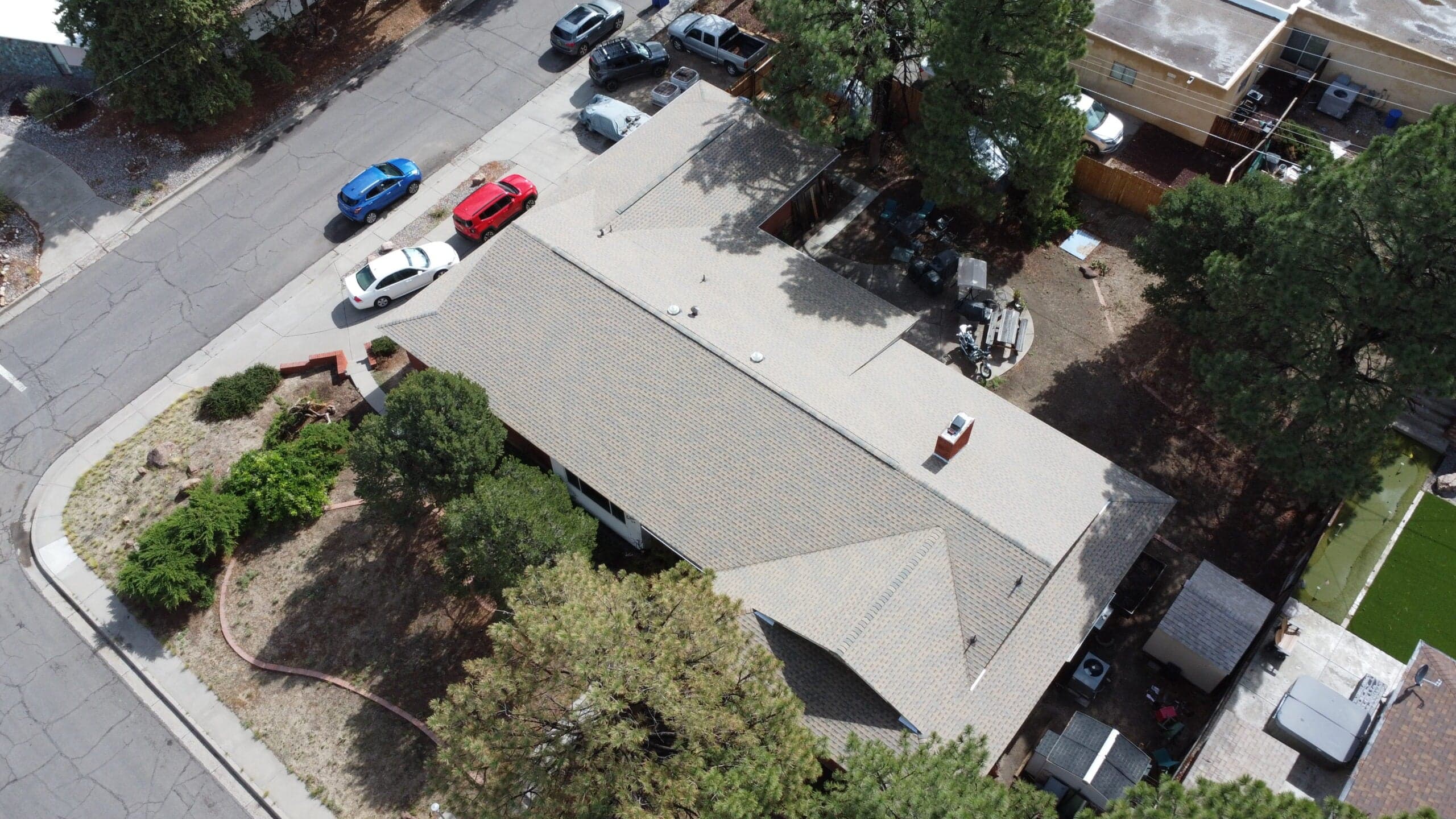
Roof replacement in Albuquerque costs $8,000–$25,000 depending on material and home size. Asphalt shingles last 20–25 years in NM's high-UV climate (shorter than the national average), while metal roofing lasts 40–70 years. The key to a long-lasting ABQ roof is choosing the right material for the desert Southwest and hiring a GAF Master Elite certified installer who understands hail damage, thermal cycling, and intense UV exposure.
Albuquerque's Unique Roofing Challenges
Every city has its own set of roofing problems. Albuquerque's are distinct — and if your roofer does not understand them, you will pay for it sooner than you should.
Intense UV Exposure
Albuquerque receives over 310 days of sunshine per year and sits at 5,312 feet of elevation. That means your roof absorbs more ultraviolet radiation than roofs at lower elevations. UV breaks down asphalt shingles at the molecular level — the oils that keep them flexible evaporate, the granules that protect them loosen, and the shingles become brittle and prone to cracking.
This is the single biggest reason roofs in Albuquerque have shorter lifespans than the same materials in other climates. A 30-year architectural shingle might last 30 years in the Pacific Northwest. In Albuquerque, expect 20-25 years under normal conditions.
Hail and Monsoon Season
From late June through September, Albuquerque's monsoon season brings intense thunderstorms that can drop hail ranging from pea-sized to golf-ball-sized. The 2023 and 2024 monsoon seasons both produced significant hail events across the metro area, and 2025 was no different.
Hail damage is not always obvious from the ground. A storm can compromise your shingles' integrity without producing visible holes or missing pieces. That is why a professional inspection after any significant hail event is important — more on that later.
Thermal Cycling
Albuquerque's high desert climate means large daily temperature swings. In spring and fall, it is common to see 40-degree temperature shifts between daytime highs and overnight lows. Your roofing materials expand and contract with every cycle. Over years, this repeated stress loosens fasteners, cracks flashing, and degrades sealants.
The Flat Roof Tradition
New Mexico's architectural tradition includes a high proportion of flat and low-slope roofs — the pueblo and territorial styles that define much of Albuquerque's housing stock. Flat roofs have different maintenance requirements and failure modes than pitched roofs. Ponding water, membrane degradation, and parapet flashing failures are common issues that pitched-roof homeowners never encounter.
If you have a flat roof, you need a roofer who understands TPO, modified bitumen, and built-up roofing systems — not just shingles.
Roofing Materials Compared
Choosing the right material for Albuquerque's climate is one of the most important decisions you will make. Here is an honest comparison of the four most common options.
Asphalt Shingles
Asphalt shingles remain the most popular residential roofing material in Albuquerque, and for good reason — they offer a strong balance of performance, appearance, and cost.
Best option: GAF Timberline HDZ
We install GAF Timberline HDZ as our standard asphalt shingle. It is the best-selling shingle in North America, rated for 130 mph winds, and backed by one of the industry's strongest warranties.
- Cost: $4.50-$7.00 per square foot installed
- Lifespan in ABQ: 20-25 years
- Pros: Affordable, wide color selection, fast installation, excellent warranty (especially with a GAF Master Elite installer)
- Cons: Shorter lifespan than tile or metal in ABQ's UV environment
- Best for: Most Albuquerque homes, especially if you are planning to add solar within a few years
Concrete and Clay Tile
Tile roofs are a natural fit for Albuquerque's Southwestern aesthetic. They last significantly longer than asphalt in our climate, but they cost more upfront and have structural requirements.
- Cost: $9.00-$16.00 per square foot installed
- Lifespan in ABQ: 40-60 years (concrete) to 75+ years (clay)
- Pros: Exceptional longevity, fire resistant, excellent in high-UV environments, beautiful on Southwestern-style homes
- Cons: Heavy (may require structural reinforcement), higher cost, more complex repairs, individual tiles can crack from hail impact
- Best for: Adobe, pueblo, and territorial-style homes where longevity and aesthetics are priorities
Standing Seam Metal
Metal roofing has gained significant traction in Albuquerque over the past decade. It performs exceptionally well in our climate and offers unique advantages for homeowners planning solar.
- Cost: $10.00-$18.00 per square foot installed
- Lifespan in ABQ: 40-70 years
- Pros: Reflects solar heat (reducing cooling costs), hail resistant, ideal for solar (clamp-on mounting with zero penetrations), fire resistant, recyclable
- Cons: Higher upfront cost, can be noisy in heavy rain or hail without proper underlayment, limited local installer expertise
- Best for: Homeowners planning solar installation, modern-style homes, or anyone who wants a 50+ year roof
TPO/Flat Roof Systems
For flat and low-slope roofs — common in Albuquerque's pueblo-style architecture — TPO (thermoplastic polyolefin) has become the industry standard.
- Cost: $5.50-$9.00 per square foot installed
- Lifespan in ABQ: 15-25 years
- Pros: Excellent UV resistance, reflective (reduces cooling costs), seamless when heat-welded, lightweight
- Cons: Requires proper drainage design, shorter lifespan than pitched-roof materials, puncture-prone without protective walkway pads
- Best for: Flat and low-slope pueblo-style roofs, parapet-walled structures
Quick Comparison Table
| Material | Cost/sq ft | ABQ Lifespan | Hail Resistance | Solar Compatibility |
|---|---|---|---|---|
| Asphalt (GAF HDZ) | $4.50-$7.00 | 20-25 yrs | Moderate | Good |
| Concrete Tile | $9.00-$14.00 | 40-60 yrs | Moderate | Good (with care) |
| Clay Tile | $12.00-$16.00 | 75+ yrs | Moderate | Good (with care) |
| Standing Seam Metal | $10.00-$18.00 | 40-70 yrs | Excellent | Excellent |
| TPO (Flat) | $5.50-$9.00 | 15-25 yrs | Low-Moderate | Good |
How Much Does a New Roof Cost in Albuquerque?
Roof pricing in Albuquerque depends on three main factors: your roof's size, the material you choose, and the complexity of the job.
Average Costs by Material
For a typical 2,000 square foot Albuquerque home (roughly 22-26 roofing squares):
| Material | Typical Range |
|---|---|
| Asphalt Shingles | $8,000-$16,000 |
| Concrete Tile | $18,000-$32,000 |
| Standing Seam Metal | $20,000-$40,000 |
| TPO Flat Roof | $10,000-$20,000 |
These are installed costs including tear-off, disposal, underlayment, flashing, and labor.
Factors That Affect Cost
- Roof size. Measured in roofing squares (1 square = 100 sq ft). A larger roof costs more in absolute terms but often less per square foot.
- Pitch/slope. Steeper roofs require more safety equipment and slower work, increasing labor costs. Standard pitch (4:12 to 8:12) is the most efficient to install.
- Number of layers. If your existing roof has two layers of shingles, both must be removed before installing new material. More tear-off means more labor and disposal costs.
- Decking condition. Rotted or damaged decking must be replaced before new roofing goes on. Most homes need at least some decking repair — budget $50-$75 per sheet of OSB or plywood.
- Penetrations and details. Skylights, vents, chimneys, and parapet walls all require custom flashing work. More details mean more labor and material.
- Access. Two-story homes, steep lots, and tight driveways can increase labor costs due to the extra effort required to move materials.
Get an Accurate Estimate
Online calculators give rough numbers, but every roof is different. The only way to get an accurate price is a professional inspection. We offer free roof inspections with drone photography so you can see exactly what we see — no guessing, no surprises.
Signs Your Roof Needs Replacement
We wrote a full post on the top signs your roof needs replacement. Here is a summary with additional Albuquerque-specific signals to watch for.
The Five Clear Signs
- Your roof is 20+ years old. In Albuquerque's UV environment, asphalt shingles degrade faster than their rated lifespan suggests.
- Curling or buckling shingles. The UV has baked out the volatile oils, and the shingles have lost their flexibility.
- Heavy granule loss. Check your gutters after rain. Significant granule accumulation means your shingles are losing their protective coating.
- Daylight visible in the attic. If light gets in, so does water.
- Sagging sections. This indicates structural damage to the decking or supports.
ABQ-Specific Warning Signs
- Cracked or missing flashing around parapet walls. Extremely common on pueblo-style homes. The thermal cycling in Albuquerque breaks down flashing sealants faster than in more temperate climates.
- Bubbling or blistering on flat roofs. Indicates moisture trapped beneath the membrane — a common failure mode when flat roofs are not properly vented.
- White or chalky residue on shingles. This is the final stage of granule loss, where the asphalt substrate is directly exposed to UV. Replacement is urgent at this point.
- Increased cooling costs. A deteriorating roof loses its reflective properties. If your summer electricity bills are climbing without other explanation, your roof may be the culprit.
- Post-hail inspection findings. After any significant hail event, have your roof inspected. Hail damage often is not visible from the ground but shows clearly in close-up inspection — soft spots in shingles, cracked tiles, dented metal.
The Roof Replacement Process
Knowing what to expect removes the stress. Here is the typical timeline for a roof replacement in Albuquerque.
Step 1: Professional Inspection (Day 0)
We inspect your roof using a combination of on-roof assessment and drone photography. You receive a detailed report with photos showing every area of concern. If repair makes more sense than replacement, we will tell you.
Step 2: Proposal and Material Selection (Days 1-3)
Based on the inspection, we prepare a detailed proposal including:
- Recommended material with options at different price points
- Complete scope of work (tear-off, decking repair, flashing, ventilation)
- Total cost with no hidden fees
- Timeline for completion
- Warranty details
- Financing options if needed
Step 3: Scheduling and Permits (Days 4-10)
Once you approve the proposal, we pull the necessary permits from the City of Albuquerque and schedule your installation. We order materials and coordinate delivery to your property.
Step 4: Tear-Off and Installation (Days 11-15)
Installation day arrives. Here is what happens:
- Morning: Crew arrives, protects landscaping and siding with tarps, sets up safety equipment
- Tear-off: Old roofing material is stripped down to the deck. We inspect every square foot of decking and replace any damaged sections.
- Underlayment: Ice and water shield or synthetic underlayment goes down first
- Flashing: All penetrations, valleys, and edges get new flashing
- Roofing material: Shingles, tile, or metal goes on according to manufacturer specifications
- Cleanup: Magnetic sweeps for nails, debris removal, property walk-through
Most residential roofs take 2-5 days for installation, depending on size and complexity. We work clean — your property will look better when we leave than when we arrived.
Step 5: Final Inspection (Days 16-18)
A city inspector verifies the installation meets building code. We walk the property with you to confirm everything meets your expectations.
Hail Damage and Insurance Claims
Hail damage is one of the most common reasons Albuquerque homeowners need roof work. If you suspect hail damage, here is the right way to handle it.
How to Identify Hail Damage
Hail damage looks different on different materials:
- Asphalt shingles: Circular areas where granules are knocked off, exposing dark asphalt underneath. May also show soft spots where the fiberglass mat is fractured beneath the surface.
- Tile: Cracked or broken tiles, often in a pattern across the roof
- Metal: Dents or dimples in the panel surface
- Flat/TPO: Circular bruises or punctures in the membrane
Why You Need a Professional Inspection First
Do not call your insurance company before having a roofer inspect your roof. Here is why:
- You need documentation. A professional inspection provides detailed photos and a written report that supports your claim.
- You need accurate scope. An adjuster's job is to settle claims for as little as possible. If you do not know the full extent of the damage, you may accept an inadequate settlement.
- Timing matters. Most insurance policies require claims within one year of the damage event. Get inspected promptly after any hail storm.
Working With Your Insurance Adjuster
- Be present during the adjuster's inspection. Have your roofer there too if possible.
- Provide your roofer's inspection report to the adjuster at the time of their visit.
- Get the full scope in writing. The adjuster should document every damaged area, not just the most obvious ones.
- Understand your deductible. Most homeowners' policies in New Mexico have a 1-2% deductible for wind and hail claims. On a $350,000 home, that is $3,500-$7,000 out of pocket.
- Do not accept the first offer if it seems low. You have the right to a supplemental inspection and re-review.
We help Albuquerque homeowners navigate insurance claims every monsoon season. It is one of the most common calls we take from July through September.
GAF Master Elite: Why It Matters
Not all roofing contractors are equal, and the certification that matters most is GAF Master Elite.
What Is GAF Master Elite?
GAF is the largest roofing manufacturer in North America. Their Master Elite program is their highest tier of contractor certification. Only the top 2% of roofing contractors in the country qualify.
Requirements for Certification
To earn and maintain GAF Master Elite status, a contractor must:
- Be properly licensed and insured in their state
- Have a proven track record of quality installations
- Commit to ongoing professional training
- Maintain high standards of customer satisfaction
- Use GAF products according to manufacturer specifications
What It Means for You
The practical benefit of choosing a GAF Master Elite contractor is warranty coverage. Only Master Elite contractors can offer the GAF Golden Pledge Warranty, which provides:
- 50-year, non-prorated material coverage on the shingles
- 25-year workmanship coverage backed by GAF, not just the installer
- Wind warranty up to 130 mph
That workmanship coverage is critical. If a non-Master Elite installer makes a mistake, you are relying on that company to honor their warranty. If a Master Elite installer makes a mistake, GAF backs the warranty directly. Even if the roofing company goes out of business, your warranty survives.
Verify Before You Hire
You can verify any contractor's GAF certification at gaf.com. If a roofer claims to be GAF certified but is not listed on the GAF website, walk away.
Roof Plus Solar: The Smart Combo
If your roof is nearing the end of its life and you are considering solar, doing both projects together is the single smartest move you can make.
Why Bundle?
Avoid double labor costs. If you install solar on a roof that needs replacement in 5-10 years, you will pay $2,000-$5,000 to remove and reinstall the panels when the roof is replaced. Doing both together eliminates that future expense entirely.
Coordinated engineering. When we install a new roof and solar together, the roof is designed with the solar array in mind from the start. Racking attachment points are integrated into the installation, and the roof layout is optimized for panel placement.
Single timeline. Two separate projects mean two separate disruptions to your life — two permitting processes, two inspection schedules, two sets of crews. A combined project cuts the total timeline by 30-40%.
Bundled pricing. When you combine a roof and solar installation with Epex, you benefit from shared mobilization costs, coordinated material ordering, and reduced overhead. The total is less than doing the projects separately.
One point of contact. If a roof leak develops near a solar mounting point three years from now, who is responsible — the roofer or the solar company? When one company does both, there is no finger-pointing. We own the entire system.
Read more about the whole-house approach in our energy performance guide.
Frequently Asked Questions
How do I know if I need a repair or a full replacement?
As a general rule: if the damage is localized to one area and your roof is under 15 years old, a repair is usually sufficient. If the damage is widespread, the roof is 20+ years old, or you are experiencing recurring issues, replacement is the better investment. We will always give you an honest recommendation — if a $500 repair solves your problem, we will tell you.
How long does a roof replacement take?
Most residential roofs in Albuquerque take 2-5 days for the actual installation. The total project timeline — including inspection, permitting, and scheduling — is typically 2-3 weeks from agreement to completion.
Should I repair my roof before selling my house?
A new roof is one of the highest-ROI improvements you can make before selling. It eliminates a major inspection concern and gives buyers confidence. In Albuquerque's market, a new roof can increase your sale price by $10,000-$15,000 or more while removing a common negotiation obstacle.
Does a new roof increase my property taxes?
In New Mexico, routine maintenance and repair — including roof replacement — does not trigger a reassessment of your property value for tax purposes. Your property taxes should not increase from a new roof alone.
Can you match my existing tile if I only need a partial replacement?
In many cases, yes. We work with multiple tile suppliers and can often source matching profiles and colors. For discontinued tiles, we may need to use a close match or explore custom options. We will always show you the options before proceeding.
Do you work on commercial roofs?
Yes. We handle commercial roofing projects across the Albuquerque metro, including TPO, EPDM, and metal systems. Contact us for a commercial roofing assessment.
Ready for a New Roof?
Whether you are dealing with hail damage, an aging roof, or planning ahead for solar, the first step is always the same: a professional inspection that tells you exactly where you stand.
Every Epex roof inspection includes:
- Drone photography documenting every section of your roof
- Detailed condition report with specific findings and recommendations
- Honest assessment — repair or replace, with clear reasoning
- Free, no-obligation estimate if replacement is recommended
Schedule your free roof inspection or call us at 505-460-8795.
We are a locally owned, GAF Master Elite certified roofing contractor serving Albuquerque and the surrounding communities. We have built our reputation on honest assessments, quality installations, and the kind of warranty coverage that only the top 2% of roofers can offer.
Frequently Asked Questions
Asphalt shingle roofs cost $8,000–$15,000, tile roofs $15,000–$25,000, and metal roofs $12,000–$25,000, depending on home size and complexity. GAF Master Elite installers provide the strongest warranties.
Asphalt shingles last 20–25 years, concrete/clay tile 40–50 years, and metal roofing 40–70 years in ABQ's high-UV climate. UV exposure reduces lifespan compared to national averages.
Homeowners insurance typically covers roof damage from hail, wind, and storms — which are common during ABQ's monsoon season (June–September). Document damage promptly and get a professional inspection.
GAF Timberline HDZ asphalt shingles are the most popular choice for their balance of performance, appearance, and cost. Metal roofing is best for longevity (40–70 years) in NM's UV-intense climate.